What is a GSP?

A Groundwater Sustainability Plan (GSP) or Alternative Plan is a document that outlines how the GSAs will implement, manage and measure the results of specific actions for the health and viability of the groundwater basin. The California Department of Water Resources (DWR) will evaluate GSPs or Alternative Plan to provide the GSA with an assessment of the plan and any necessary recommendations every five years following its establishment.
Is the State trying to take over control of groundwater?

SGMA provides a framework for improving management of groundwater supplies by local authorities. SGMA actually limits State intervention, provided that local agencies develop and implement GSPs or Alternative Plans as required by the legislation. Under SGMA, local agencies now have tools and authorities some agencies previously lacked to manage for sustainability. Under a limited set of circumstances, the State Water Resources Control Board (SWRCB) may step in to help protect local groundwater resources. The process of SWRCB only occurs if local efforts to form a GSA or develop and implement a viable GSP are not successful. In the Indio Subbasin, we have four approved GSAs and an approved Alternative Plan.

Why was SGMA established?

Over the years, California water managers have observed a decline in water levels in aquifers in some areas of the state. Impacts and issues related to the decline is apparent. For example, some wells in the Central Valley have experienced declines in excess of 100 feet during the drought and increases in groundwater pumping have exacerbated some areas of land subsidence, which threatens infrastructure such as roads, canals and bridges. In January 2014, the California Governor’s Office identified groundwater management as one of ten key action steps in its California Water Action Plan. SGMA, signed into law months later, follows up on that action, giving local agencies the ability to manage their respective basins following statewide guidelines.

Is SGMA related to the drought?

SGMA is not directly related to drought; sustainable groundwater management is a long-term vision and commitment to manage groundwater judiciously so that it is protected for future use. In many areas, over time, the water table, or the depth at which groundwater can be found, has gotten much deeper below the surface. As demand for groundwater has increased, more water is being drawn out of aquifers than is replaced or replenished. Low groundwater levels can cause a number of undesirable results such as land subsidence (sinking of the ground’s surface). Some California groundwater basins have reached all-time historic lows. Creating a framework for State oversight (through SGMA) ensures a standard, consistent process to maintain and actively monitor and manage basins at the local level.

What is the Sustainable Groundwater Management Act (SGMA)?

The Sustainable Groundwater Management Act (SGMA), signed into law in 2014, provides a framework for long-term sustainable groundwater management across California. SGMA applies to all California groundwater basins and requires that local and regional authorities in designated medium- and high-priority groundwater basins form a locally-controlled and governed Groundwater Sustainability Agency (GSA), which will prepare and implement a Groundwater Sustainability Plan (GSP) or an Alternative Plan. In the case of the Indio Subbasin, the region’s water purveyors had already developed an Alternative Plan (the 2010 Coachella Valley Water Management Plan Update) which was submitted to the State under SGMA. Of the 109 medium- and high-priority basins identified by the California Department of Water Resources, the Indio Subbasin Alternative Plan is only one of nine approved alternative plans under SGMA.  

What will the Alternative Plan do for groundwater management?

The Indio Subbasin Alternative Plan continues water management efforts began in 2002 with development of the 2002 Coachella Valley Water Management Plan, while updating Subbasin information and management strategies in compliance with new State regulations. The Alternative Plan will describe a pathway for managing the groundwater basin and describe measures to ensure that the Indio Subbasin operates within a sustainable goal for groundwater use. See the “What is the Alternative Plan” below for more information.

How is the Indio Subbasin managed?

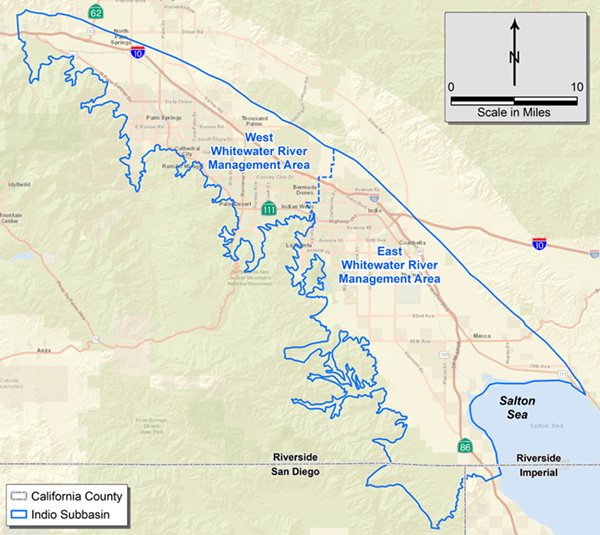
The Indio Subbasin has been managed for many years by the local water agencies. The Subbasin is divided into two management areas: the West Whitewater River and the East Whitewater River management areas. The dividing line between these two management areas is an irregular line (see map below) which stretches between Washington Street and Point Happy to the Indio Hills near Jefferson street.

The West Whitewater River management area is jointly managed by Coachella Valley Water District and Desert Water Agency under the terms of the 1976 Water Management Agreement. The East Whitewater River management area is managed by the Coachella Valley Water District. Desert Water Agency and Coachella Valley Water District operate a groundwater replenishment program to help fund groundwater recharge into the Indio Subbasin. CWA, IWA, and other large private and municipal pumpers pay a “Replenishment Assessment Charge” for each acre-foot of groundwater pumped.

What is the water cycle and how does it relate to groundwater supplies?

The earth has limited supplies of water. Groundwater and surface water are essentially one resource, physically connected by the water cycle in which water evaporates, forms clouds, and falls to the ground as rain or snow. Some of this precipitation seeps into the ground and becomes groundwater that moves slowly into an underground aquifer.  If there is no precipitation, then there is no water returning to the groundwater below and the groundwater supply is not “recharged” or refilled.

What does “groundwater sustainability” mean?

SGMA defines groundwater sustainability as “the management and use of groundwater in a manner that can be maintained during the planning and implementation horizon without causing undesirable results.” What does this mean? A sustainable groundwater basin is one in which the water use is balanced with the water replenishment from rainfall, surface water, and other sources.